VOICES & Visions
1. Commercial / Brand Related Architecture
Discovery Place
The 112 000m² headquarters for health and financial services group Discovery redefined the possibilities of large-scale commercial architecture in Africa.
It was the first commercial office development of its scale on the continent to achieve a 5-Star Green Star Design Rating – later upgraded to a 6-Star As-Built Rating, denoting “World Leadership”. It is a welcoming, low-slung, curvilinear structure designed to encourage public access. The ground floor invites the city into the building with 10 reception points and pedestrian access from all sides. A central concourse, inspired by a ‘Grand Central Station’, invites the city into the building, acting as a precinct connector, supporting Discovery’s place-making mission and enabling a vibrant interface between the company and its community.
Inside, two light-filled atriums, capped with a huge glazed roof, form the heart of the building. Gently curving atrium edges humanise the volumes, enhancing lines of sight and ease of orientation. The external form of the building originates in the fluidity of the internal spaces. Its expressive glass veil with white aluminium fins, and its curving lines and cantilevered elements project the building’s ethos in the wider city.
The rooftop – accessible to all employees – features an undulating running track, sports and recreation facilities.
Dr Susan Nel Dental Studio
Dr Susan Nel Dental Studio specialises in the art of aesthetic dentistry, where precision, beauty, and wellbeing are seamlessly intertwined. The interior was conceived as a reflection of this philosophy-balancing clinical excellence with a calm, inviting atmosphere. Rather than presenting as a sterile medical environment, the space embraces a more considered and human-centred approach, celebrating a practice of exceptional standards through materiality, light, and spatial composition.
ARCA Unlimited responded to the brief by crafting a first-class environment that instils both comfort and confidence. Transparency and trust are expressed through floor-to-ceiling glazed consultation rooms, softened with subtle decals that maintain privacy while preserving visual openness. The waiting area introduces a striking yet gentle focal point, featuring an oversized floral X-ray graphic that merges the precision of science with the softness of nature. This layered design language creates a space that feels both sophisticated and reassuring.
A recent renovation has allowed the interior to evolve, refining its contemporary expression while continuing to prioritise patient experience, sensory comfort, and a timeless sense of understated luxury.
Exemplar Head Office
The Exemplar Head Office design addresses the need for a larger, more efficient workspace while retaining the intimate, human-scaled character of their previous residential offices.
The building is approached by means of a winding path. Mature trees were retained on site, screening the parking and reinforcing the domestic, farmhouse feel of the building. The mass of the building is broken into linear “wings”, which saturates the internal spaces with natural light and garden views. Where internal spaces become too deep, a courtyard is introduced. The courtyard is covered in translucent sheeting and is heavily vegetated. This has a dual purpose: firstly, biophilic design is scientifically proven to enhance productivity, and secondly, the atrium provides a sheltered gathering space where social events are held, spilling out onto a pergola covered veranda and lawn.
The building’s material palette, spatial arrangement, and emphasis on patios offer a modern interpretation of traditional Transvaal architecture.
Lynnridge Walk
The refurbishment of a 1970s retail centre in Pretoria reimagines a once-thriving destination, restoring its original spirit while repositioning it for contemporary retail and community life. Following multiple prior upgrades, Boogertman + Partners sought to re-establish human scale, vibrancy and social connection through a design-led intervention.
Rather than a purely aesthetic upgrade, the project strategically transforms the traditional inward-facing mall into an outward-oriented, people-centred environment. Restaurants and cafés line the edges, activating façades and engaging both street and parking interfaces. Circulation is enhanced through non-linear pathways, improved permeability and a “walk-through retail” concept, where select stores function as both retail space and movement routes.
Working within the constraints of layered structures from different eras, the design softens the architecture and introduces a tactile, nature-inflected palette inspired by the nearby Faerie Glen Nature Reserve. Raw timber, rusted steel, textured plaster and integrated planting create warmth and authenticity, while layered ceilings and curved forms enhance spatial flow and visual connectivity.
The result is a revitalised mixed-use environment that extends beyond retail, accommodating Oakfields College and positioning the mall as a vibrant social hub and contemporary “third place”.
Mercedes Benz HQ – Office Space
Occupying two and a half storeys within a multi-level building, the design was driven by the intention to dissolve traditional departmental boundaries and foster a culture of collaboration. ARCA Unlimited reimagined the office by opening up each floor plate, consolidating services around existing cores and positioning open-plan workspaces along the façades. This strategy maximises natural light, views, and a constant visual connection to the surrounding landscape.
A continuous circulation route connects all departments, encouraging collaboration and movement. Inspired by the Zwartkops campus, the layout follows a softer, more organic path instead of a rigid office corridor.
The workspace was conceptualised as an extension of the home, accommodating a diverse workforce through a variety of adaptable settings. From collaborative zones to private booths and quiet workstations, each space responds to different personality types and working styles. Sensory elements such as colour, texture, sound, and scent further enrich the environment. Heritage is thoughtfully embedded through curated artwork and spatial naming, carrying forward the legacy of both Mercedes-Benz and the Zwartkops campus into a contemporary, people-centred workplace.
Plato Coffee Garsfontein
The client brief called for an iconic pocket of space embedded within a suburban context—one that would act as a hub of connection and interaction for both the local community and visiting patrons.
Indigen Architect’s response, sought to draw people seamlessly from the street into a calm, introspective environment: a quiet retreat from the quotidian noise of daily life. Central to this ambition was the creation of a spatial experience that reduces visual stimuli, fosters mental clarity, and subtly communicates the Plato brand through the ritual of crafting the perfect cup of coffee.
The concept of “White Space,” drawn from its literary definition as the blank area on a page that allows the eye to rest and the mind to process, informed the architectural language of the Plato store. This principle guided a rigorous process of subtraction, stripping away all unnecessary visual and operational clutter to reveal a distilled environment. The result is a space that momentarily removes the user from everyday distractions, offering a sensory pause that redirects focus toward the performative act of coffee-making. A careful equilibrium between restraint and richness underpins the design—ensuring the space reads not as empty, but as a luminous, immersive void where light, texture, and form coalesce into a refined simplicity. Every element, from the ergonomic choreography of the baristas to their visibility and engagement with customers, extends to the bespoke design of production equipment, furniture, and signage, reinforcing a cohesive and intentional spatial narrative.
Village Walk
The client envisioned a conceptual and physical link between the rustic character of The Village and the more structured Club Precinct.
Village Walk is a deliberate urban intervention, engaging with spatial, economic, and cultural aspects of South African cities. It extends the city through a pedestrianised connection between two active nodes.
The architectural response of Village Walk responds to the brief through a curated tenant mix and fine-grained detailing. Hazelwood has developed a unique cultural identity – where coffee, cuisine, and street life have organically taken root.
The project responds to the evolving urban fabric of Hazelwood, Pretoria, by addressing key architectural concerns: walkability, environmental sustainability, and the need for accessible public space.
Buildings activate the street edge, forming a lively interior public realm, supported by landscaping, seating, and subtle level changes that guide movement and enhance comfort.
Materially, the design echoes the informality of The Village while referencing the refinement of The Club. Face brick, concrete breezeblocks, and painted brick provide texture and permanence, while steel and timber elements introduce lightness and warmth.
Village Walk supports both movement and pause, offering a square for gathering. Its success is evident in daily use: active retail, restaurants, and regular events. Operating for over two years, it continues to host community activity, reinforcing human-scaled, context-driven city-making that places people at the centre of the architectural experience
Smile Solutions – Dental Practice
The prime area of the acquired building was occupied by existing tenants, who needed to be retained for reasons of viability. The space available for the practice was dark, fragmented, and arranged around a service yard, with small, claustrophobic rooms at varying levels. Hidden behind a high solid brick wall, the building’s entrance felt uninviting, with access contrived through the tenant area.
To improve natural light and create a more welcoming environment, the service yard was transformed into a landscaped courtyard, while brick walls facing consultation spaces and surgeries were replaced with glass shopfronts. At the heart of the courtyard, a Japanese maple grows beneath an oval roof opening, chosen for its seasonal colour changes from green to burgundy and scarlet, eventually revealing dark-red bark in winter. Curved and oval forms introduce softness to the rigid geometry, echoing the naturalistic curation of Japanese gardens.
A transparent steel gate and fence replaced part of the perimeter wall, opening views from the street through the reception to the courtyard. Floor finishes alternate between white terrazzo and reclaimed teak, while smooth plastered walls unify interior and exterior spaces, blurring boundaries and enhancing the sense of openness.
Daimler Truck Southern Africa HQ
The Daimler Truck Corporate Headquarters was designed to create a sustainable and comfortable workplace that inspires creativity, productivity, and a sense of belonging. Situated on a new, more utilitarian site compared to the natural setting of the previous HQ, the design needed to address both functional and experiential aspects beyond the original brief.
ARCA Unlimited approached the project with a vision to challenge the brief, creating a workspace that is efficient yet uplifting. The design embraces an industrial aesthetic, combining materials such as black bricks, sheet metal cladding, translucent polycarbonate sheeting, and contrasting white plastered walls. This material palette references the site’s industrial context while maintaining a connection to nature.
Interior comfort was a key focus. High-specification acoustic glass, insulated meeting rooms, and suspended acoustic dampening panels create a calm environment that reduces distractions and allows employees to focus despite the nearby major roadways.
The result is a headquarters that balances functionality with wellbeing, offering a workplace that is not only efficient but also thoughtfully designed to foster collaboration, engagement, and a positive employee experience.
BMW East Rand
The BMW site is located on a prominent road in the East Rand, sharing access with an adjacent retail development. To distinguish the dealership from the retail component, the building was positioned as close to North Rand Road as possible and raised on a platform. This elevation allows passersby to see into the showroom over parked cars, showcasing premium vehicles and drawing public interest.
The success of the dealership relies on the careful orchestration of its functions. New car sales are supported by service clients entering the showroom, so parts, retail, and service advisors were strategically placed at the building’s heart. This ensures that visitors encounter enticing vehicles no matter where they move through the space.
BMW’s architectural principles guided the design, with orthogonal white planes creating a floating, elegant showroom volume. Vehicles are arranged in a road-like formation parallel to the main road, emphasizing scale and movement. The design also accommodates the Motorrad brand, treating motorcycles as a visible part of the showroom experience. On weekends, glazed partitions open to reveal a pergola, transforming the space into an outdoor social area for biker meets and events, creating a seamless connection between display, function, and community.
Dr George Mukhari Academic Hospital – Welcome Centre
The small new building, situated in front of the existing hospital façade, needed to complement the existing architecture behind it, but also stand out as symbol of a new era for the hospital. It had to fulfill its role to ensure the public feels welcome and safe, whilst articulating ambulance traffic and patients around it.
ARCA set out to achieve a contemporary, low maintenance building, whilst paying homage to the architecture that was constructed in the 70’s. A way to achieve this was by using a similar design language and materials through repetitive column spacing and the use of facebrick. The need for undercover walkways into the building and surrounding areas was satisfied by floating concrete roof canopies linking the building’s architecture with the A&E Ward. Ambulance and pedestrian flow were considered to accommodate emergency arrivals and the safe access for general patient enquiries. This flow helped determine entrance positions as well as the Porters room location.
The existing pedestrian route to the A&E Ward was trampled to gravel and was used and formalized by creating seating and landscaping on this newly paved route into the new Welcome Centre. Consideration of typical construction details lead to the exploration of alternative details of brick bonds, shadow lines, rainwater downpipes and steel and brick column combinations. The interior design was influenced by the column rhythms, spatial orientation and acoustic performance. Acoustic materials were strategically incorporated to enhance the end user experience and aid in building legibility. Users were guided by the acoustic ceiling panels toward either the exit on the opposite side or the information desk.
Engelenburghuis Additions & Alterations
Before the completion of the project the South African Academy for Sciences and Art was fully accommodated in the historical Engelenburghuis. The beautiful old heritage house, built in 1903 in the Herbert Baker style, could no longer function effectively as a museum and became too restricted for the growing Academy. It was therefor decided to add a bespoke facility to better suit evolving operational needs, which could then also free the historical house to fulfill its heritage purpose as a proper museum.
The new addition includes offices, stores and ablution facilities, as well a reception area and boardroom on the first floor. The second floor contains gallery spaces to exhibit the Academy’s extensive art collection. These spaces double as lecture or entertainment areas, served by kitchen facilities and separate ablutions. Due to the very restricted site it was necessary to lift both these floors above the ground level to create enough parking bays. A staircase winding around a small lift is provided to vertically connect the three levels – this glazed triple volume space encapsulates the transition from the old to the new building.
The historic Engelenburghuis, with ancillary buildings was restored to its original splendor with the guidance of heritage specialists.
The design of the project aims to reflect the Academy for Sciences and Art’s relevance into the future, as well as to acknowledge the value of the historic Engelenburghuis.
Category Winner
Lucky Bread Village
Lucky Bread Village presented a rare opportunity to design a corner pavilion within a vibrant suburban streetscape. Over the past decade, this area in Pretoria has transformed organically as small residential houses were gradually converted into businesses and restaurants. The result is a collection of intimate one- and two-storey buildings on small urban parcels, forming what is now known as the Pretoria East Village—simply referred to as the Village.
In keeping with this character, Atterbury Properties, the developer, embraced variety by commissioning different architects and architectural styles for each stand, resulting in a rich, eclectic urban environment.
Positioned on a prominent corner site, Lucky Bread naturally emerged as an urban pavilion within the Village. The design embraces openness on both street edges, with a floating roof offering shade and comfort. Large portions of the site are intentionally given back to the public realm, blurring the boundary between building and street. On good weather days, the fully operable shopfront dissolves any separation between interior and exterior, allowing the space to function as an extension of the street itself.
The distinct Lucky Bread brand is expressed through a sculptural plywood roof that establishes a recognizable architectural identity. A fully 3D modelled structural system of plywood and steel was CNC cut, prefabricated, and swiftly assembled on site—demonstrating precision, innovation, and expressive tectonic design. Custom steel elements for structural supports and shopfitting further elevate the building’s craft and detail.
The restrained palette of creams and blues complements Lucky Bread’s bold corporate red, reinforcing the brand while enhancing the architectural character. This project delivers a finely tuned design—crafted specifically for its urban setting and the Lucky Bread customer experience.
Lynnwood Galleries
This refurbishment transformed an ageing, underperforming shopping centre in Lynnwood, Pretoria – adjacent to the Rosemary Forum office building – into a vibrant mixed-use destination that reconnects commerce, work and community.
While the existing structure was largely retained, the internal spaces and surrounding precinct were reimagined as a lively, outward-facing urban hub. A refreshed tenant mix, activated restaurant edges and a more porous public realm introduce visible activity. The concept links the social energy of Lynnwood Galleries with the workplace environment of Rosemary Forum, creating a seamless flow between retail, office and community life.
The Rosemary Forum interiors were redesigned to feel warm and connected, with a sculptural spiral staircase, layered lighting and visual links between floors fostering interaction and spatial continuity. Boogertman + Partners was also responsible for the interior design of key restaurants and reinventing the internal atrium space in the centre.
A key strength of the project lies in the integration of architecture, interiors, landscape and movement. New walkways, pergola structures and improved façades reinforce connectivity, while landscape interventions – retaining mature trees and introducing new planting – soften the site and enhance the pedestrian experience.
Subtle strategic interventions have transformed a neglected asset into a vibrant destination that has boosted confidence in the neighbourhood.
Pharoah Auto
ARCA Unlimited was commissioned to transform an existing dealership on Winnie Mandela Drive in Bryanston into the flagship showroom for Pharoah Auto Investments. Positioned on a prominent corner site in Sandton, the design engages with the city’s urban energy while redefining the traditional automotive experience.
The brief extended beyond a standard showroom into a lifestyle-driven luxury destination. Pharoah Auto’s clientele, including creatives, athletes, and cultural entrepreneurs, experience luxury through identity and community. The vision was clear: less showroom, more stage.
Spread across two levels, the upper floor is light-filled and gallery-like, displaying vehicles as curated artworks alongside a coffee bar, retail spaces, offices, and a prayer room. The lower level provides a darker, immersive environment for car reveals, brand launches, and events, supported by a photo studio and media spaces.
Clad in IBR sheeting with bold steel and glass, the façade establishes a strong, monolithic presence while framing views toward Winnie Mandela Drive. A floating steel halo marks the entrance and reinforces the brand identity.
Pharoah Auto transcends the idea of a dealership, becoming a cultural destination where luxury, performance, and community converge. It reflects Johannesburg’s ambition while setting a new standard for automotive architecture in Africa.
2. Interior Design Projects
Category Winner
Annam Viet Cuisine
Stepping into Annam Viet Cuisine in Pretoria East immediately signals a design-forward experience rooted in atmosphere and spatial intent rather than just culinary presentation. The design choices play a key role in shaping the restaurant’s inviting ambience, creating a space that feels warm, comfortable, and refined.
From the moment guests enter, there’s a thoughtful balance between warmth and openness. Materials, lighting, and layout work together to craft an environment where the interior feels calm and anchored. Warm tones and layered textures in walls, floors, and furniture enhance the sense of comfort while defining the dining areas and encouraging lingering and connection.
Architectural decisions also guide movement and engagement. Large seating zones, clear circulation paths, and intentional fixtures create a functional and aesthetically pleasing space that complements the restaurant’s identity. The interiors frame activity, support social interaction, and elevate the experience of gathering, making the environment itself a key part of the Annam Viet Cuisine story.
Brewers Ice-Cream
A playful reimagining of the classic ice-cream parlour, where nostalgia melts into moments of pure, joy-filled indulgence.
As a sister brand to the established Brewers BBQ, the store introduces a whimsical identity while maintaining the core values of community and family. A newly articulated entrance enhances visibility and accessibility from the mall, inviting passersby into a vibrant, engaging environment offering soft serve, frozen yogurt, and waffles.
The interior balances clarity with delight. Clean lines are offset by soft pastel accents, while scalloped yellow lighting—referencing traditional shop awnings—creates a recurring visual motif. This detail extends into the cabinetry, subtly evoking childhood memory and reinforcing a sense of nostalgia.
Custom-designed furniture responds directly to the irregular proportions of the space, transforming a spatial challenge into a defining feature. Bespoke joinery and seating elements, crafted in collaboration with local partners, introduce colour, texture, and cohesion.
The result is a compact yet expressive environment that celebrates both heritage and innovation, offering a memorable sensory experience within a constrained footprint.
PLATO COFFEE VOLLEY BROOKLYN
Plato Coffee Volley Brooklyn, designed by Indigen Architects, is conceived as an interactive social hub that extends beyond its primary function to serve Volley students, fostering connection, engagement, and community exchange.
The space blurs the boundary between campus and neighbourhood, creating an inclusive environment for gathering and collaboration. A series of custom-designed steel elements and bespoke joinery anchor the interior, seamlessly linking soft leather booth seating with the operational counter and display areas. These interventions guide movement and frame views, establishing a cohesive spatial language that balances tactile warmth with functional precision.
Customer engagement was central to the design, with the counter configured to encourage direct interaction with baristas, while carefully considered ergonomics support efficient workflow and ease of operation. Abundant indoor planting and a calming sage green palette extend the interior toward the adjacent courtyard—central to the campus—softening industrial elements and reinforcing a strong visual and atmospheric connection between inside and out.
Brewers BBQ
Brewers BBQ, located in Waverley Plaza, Pretoria, has served as a cherished community institution for nearly 30 years. Known for its loyal clientele and personal atmosphere, the restaurant’s redesign required a careful balance between preservation and renewal. The brief called for a family-friendly environment that retained the essence of the brand while enhancing its spatial and operational qualities.
Indigen Architects responded by extending the project beyond a simple renovation, reimagining the space as a contemporary yet familiar gathering place. The design maintains a nostalgic aesthetic, appealing to long-standing patrons, while introducing layered textures that foster warmth and approachability. Materials such as terracotta and leather are paired with a deepened interpretation of the brand’s signature blue, creating a cohesive and inviting interior language.
A key architectural move was the reconfiguration of the kitchen, prioritizing visibility and interaction between staff and patrons. This decision reinforces the restaurant’s communal identity, making food preparation part of the customer experience.
Operational efficiencies were also addressed, streamlining circulation and service to better support daily functions. The result is a space that honors heritage while embracing evolution—ensuring Brewers BBQ remains a vibrant community anchor for years to come.
Classic Lynnwood 70’s Kitchen UpgradeBefore & After Transformation
Originally constructed in the early 1970s, this kitchen carried the charm of its era but required a thoughtful and contemporary reimagining to meet modern living standards. The brief called for a refined intervention—one that would introduce a streamlined layout, increased storage capacity, and a well-lit, highly functional preparation space.
At the heart of the design lies a remarkable feature: an original Frigidaire oven and stove, imported from the United States in 1971. Carefully restored, this vintage appliance became the anchor of the entire composition. Its distinctive asymmetry informed the rhythm of the new cabinetry, guiding both proportion and layout in a way that celebrates its uniqueness rather than conceals it.
The cabinetry design responds with intentional asymmetrical divisions, enhanced by subtle routed detailing that echoes the appliance’s geometry. A curated palette of fresh green tones was selected to complement the intricate pattern embedded in the oven’s heat-resistant glazing—creating a dialogue between old and new.
Approximately 16 metres of new cabinetry—including carcasses, doors, and drawers—were constructed using standard melamine and 16mm MDF panels, all meticulously hand-painted in a harmonious shade of green. This craftsmanship introduces both durability and a bespoke finish.
Layered lighting plays a key role in shaping the atmosphere: brushed brass fittings, delicate wired basket pendants, and abundant natural light combine to create a warm, inviting environment. Solid timber surrounds and carefully boxed-in features add depth, texture, and a sense of permanence.
Underfoot, a printed timber-look vinyl was selected not only for its aesthetic warmth but also for its insulating qualities, seamlessly extending across the kitchen, scullery, and laundry areas.
A restored original timber hatch reconnects the kitchen to the dining space, preserving a sense of continuity and heritage. Decorative glass vases, sourced from across the globe, are thoughtfully displayed—adding personality and storytelling to the space.
This renovation is a celebration of contrast and continuity—where vintage character meets contemporary clarity, and where every design decision honours both function and memory.
Ultima Financial Planners – new office interior
Ultima moved from a home office into 500 m2 in an upmarket office park. They wanted a professional appearance with a cosy and homely feeling. Their existing furniture and paintings would provide familiarity in a modern, functional space.
EKIS Architects relocated the entrance door from a narrow side passage into the foyer. In Ultima’s odd-shaped reception a circular bulkhead unifies the space.
Two boardrooms share the wall-to-wall windows. The third boardroom features a mural of the Blyde River Canyon. Clients love this holiday vista.
The design was guided by what was available on site, including aluminium frames and lights.
The kitchen doubles as a staff room, very popular with the staff.
The new layout feels so obviously like the right solution that it is hard to imagine that there was a previous arrangement.
Clients’ comments:
“Your offices are light and modern, yet homely.”
“A great improvement of your previous office! Here I can breathe.”
“ Very corporate, nevertheless still cosy”
3. Pop-Up Structures / Temporary Pavilions
Category Winner
The Pulse Lounge
This temporary structure was designed as a central lounge in the main marquee at the 2025 RMB Latitudes Art Fair. Its aim was to encourage interaction between visitors and exhibitors, providing a moment of respite amid the vibrant energy of the fair. The lounge was envisioned as an indoor pavilion, with carpeted floors and sheer fabric panels subtly defining a central space without enclosing it, offering glimpses of the interior and inviting curiosity and engagement. Organic curves, overlapping forms and intuitive paths encourage a natural flow of movement into and through the space. The interior was organised around three softly defined pods each distinct in colour, scale and lighting. Two outer pods, positioned at the entrances, prioritised standing space and casual networking with high-top tables, while the central pod offered a more intimate seating area. Custom-designed textiles drew on the visual languages of the fair, its sponsor, and the design studio itself to contribute to an integrated brand experience that reinforced identity without overwhelming visitors. All elements were designed for future re-use. Through a thoughtful, immersive design experience that resonated with the fair’s values, the lounge facilitated a memorable and shareable encounter while deepening visitors’ appreciation of the surrounding art.
4. Public Work
Ivory Coast Embassy
The Embassy of the Republic of Côte d’Ivoire in Pretoria is a contemporary diplomatic landmark that expresses unity, identity, and openness. Set among Pretoria’s mature jacaranda trees, the building balances symbolic presence with contextual sensitivity while drawing inspiration from West African cultural traditions.
Its form is generated from an elliptical spiral, creating a ribbon-like volume that suggests movement, continuity, and collective aspiration. A fully glazed façade is wrapped in a woven sun-shading screen inspired by traditional Ivorian fabrics and basketry. Laser-cut stainless steel panels form a pattern of bands and diamond-shaped openings that reinterpret West African motifs while responding to solar orientation, allowing daylight and views while reducing heat gain.
The building is positioned to create a ceremonial forecourt and entrance canopy that dignifies diplomatic arrival. Internally, public reception and meeting spaces occupy the ground floor, with diplomatic offices above and a rooftop terrace for gatherings, ensuring a clear and efficient balance between civic presence, cultural identity, and diplomatic function.
Category Winner
THE PARK WILLOWS
The Park Willows, designed by Indigen Architects, is conceived as a communal hub at the heart of a vibrant suburban neighbourhood. The integration of a multi-generational pump track with a popular local coffee shop has cultivated a dynamic culture of engagement, activating the site throughout the day.
A series of robust precast concrete pod structures were carefully positioned and oriented to create shaded, naturally ventilated pockets, enabling comfortable outdoor occupation in Pretoria’s demanding climate. These elements are complemented by custom-designed concrete furniture, reinforcing the architectural language while ensuring durability within the rugged context of a bicycle park. The landscape design plays a central role, with an existing Seringa tree anchoring the composition. Preserved and celebrated, it forms the focal point of arrival—welcoming visitors and grounding the project in its local context while strengthening the park’s identity as a place of connection and pause.
ST DAVID’S MARIST BROTHERS INANDA
BOARDING HOUSE 2
The Marist Brothers founded by Marcellin Champagnat and his first Brothers in 1817 extended their schooling to Cape Town (1967) and Johannesburg (1899). St David’s campus was opened in 1931 and the building fabric has been informed by campuses abroad, largely The Hermitage.
St David’s required a new Boarding Facility for 40 Boarders and 3 Staff Members and their families.
We opted to use the architectural language of the monastic culture, with cloisters and vaults, as the campus already held the architetural quality of early renaissance forms, towers, arches and a large chapel.
We introduced a boarding facility on an axial spine with the chapel so that a phillosphers path could be created for students moving from ‘home’ to school and chapel on a daily basis. This spine culminates in a barrel vaulted entrance space and common area sited adjacent a cloistered garden around which the boarders and staff accommodation are arranged.
A double storey form with primarily 3 boys per room allows for private ablution facilities in favour or grouped ablutions, so that the facility may be used for visiting girls schools, or conferencing when Brothers attend workshops from abroad.
Borrowing the language of vault, arched and porthole windows, we aimed to create a contemporary facility which had roots in its past and valued the qualities of garden, space, peace and repose, qualities highly valued and actively encouraged in the school’s ethos of humility, simplicity and modesty.
5. Residential Alterations / Additions
Category Winner
Gagiano Conservatory
Gagiano Conservatory is a renovation and addition that creates a little heaven in the city. The clients love birds and nature and wanted their home to open up to the lush indigenous garden. The original house, designed by Lizelle Larson, was carefully respected. We added a “room in the trees” that links the house to the garden, drawing daily life closer to nature. With glass sides and alternating solid and polycarbonate sheeting, the space is filled with soft, filtered light, creating a calm place to sit, watch the birds and feel part of the garden.
HOUSE DU PLESSIS
This project, a collaboration between ARCA Unlimited and MMK Architects, involved a carefully considered addition to a stately home originally designed by Jan van de Werke. The scale of the new accommodation posed a significant challenge, with the risk of overpowering the existing structure. In response, the design adopts a restrained architectural language, defined by clean lines, angular forms, and a predominantly white palette to create a clear yet respectful contrast to the richness of the original home.
Large expanses of glazing were introduced to capture expansive views and establish a stronger connection to the surrounding landscape. This outward-facing approach contrasts with the more inward-focused nature of the historic structure, creating a dynamic dialogue between old and new.
Rather than competing with the original architecture, the additions are conceived as a subtle frame, an understated casing that enhances and celebrates the ornate character of the existing home, allowing it to remain the focal point of the composition.
House Lourens
House Lourens is a testament to the transformative potential of alteration and addition — a project that, in hindsight, may have justified complete demolition, yet instead became something far more layered and rewarding. Working within the constraints of the existing structure demanded both restraint and ingenuity, turning limitation into design catalyst.
Guided by the client’s clear and distinctive stylistic vision, the project evolved into a careful choreography between old and new. The original house was opened, reshaped, and extended to capture and celebrate its most powerful asset — the view. Where the previous structure turned inward, the new intervention dissolves boundaries, inviting light, landscape, and life deep into the home.
The success of House Lourens lies in collaboration: a committed client, a cohesive team, and a shared ambition to push beyond the expected. My involvement from inception through to completion ensured a consistent architectural narrative, where every decision contributed to the whole.
What emerged is more than a renovation — it is a reimagining. A house once constrained now breathes, expands, and elevates daily living into something quietly extraordinary.
House Nash
House Nash is a careful and deeply considered renovation that transforms an already distinguished residence into a more responsive, sustainable, and spatially expressive home. Rather than imposing a new architectural language, Krynauw Nel Associates approached the project as a process of calibration—respecting the original Studiomas design while identifying opportunities for enhancement through light, volume, and material continuity.
Central to the intervention is the unlocking of latent spatial potential: a previously underutilised top floor is activated to capture expansive views, while key living spaces are extended northwards to optimise solar orientation and environmental performance. Subtle yet strategic insertions—ranging from transparent courtyard edges and vertical glazing articulations to the introduction of a sculptural steel staircase—redefine circulation and visual permeability without disrupting the architectural integrity.
Equally, the project foregrounds a progressive sustainability ethos, favouring long-life synthetic materials and integrated water-harvesting systems over conventional, resource-intensive finishes. As noted in the project narrative, the design prioritises not only functional and economic value, but also the often-overlooked emotional resonance between inhabitant and form . The result is a nuanced synthesis of restraint and invention—an architecture of continuity, precision, and quiet transformation.
HOUSE BEST
For the renovation and extension of an existing family home in Southdowns Estate, Irene, ARCA Unlimited was tasked with unlocking the hidden potential of an outdated structure. The design approach centred on reimagining the spatial layout to create a more fluid and cohesive living environment, tailored to contemporary family life.
By introducing a sense of flow throughout the home, previously enclosed spaces were opened up to allow for better connectivity, natural light, and ease of movement. The modernisation of the design was carefully considered, balancing clean, contemporary interventions with a sensitivity to the home’s original character.
Through these thoughtful architectural adjustments, the house was transformed into a refined and functional space, where comfort and simplicity meet. The result is a renewed family home that feels both timeless and relevant, offering a harmonious balance between old and new.
House Elegance – 1067 Pecanwood
This renovation shows outstanding architectural skill by cleverly changing an old outdated shell into a modern home that focuses on sustainability. Instead of tearing down the old building, the project retains and improves its original foundation, significantly reducing energy use, carbon emissions, and unnecessary waste while demonstrating a thoughtful approach to architectural design.
At its core, the design improves daily life through a carefully orchestrated spatial transformation. Previously fragmented interiors have been opened into a cohesive sequence of interconnected living spaces, fostering ease of movement, accessibility, and social engagement. This fluidity not only enhances functionality but also cultivates a sense of belonging and comfort, aligning architecture with the rhythms of contemporary living.
Materiality shapes the experience: warm solid wood flooring introduces tactility and grounded elegance, while lighter vertical planes amplify natural light, contributing to well-being and spatial clarity. To address spatial inequality, the design replaces hierarchical, compartmentalised rooms with equitable, inclusive spaces that provide all occupants with equal dignity and purpose, turning a house into a home.
Ultimately, the project tells a compelling story about effortless, carefree luxury, where financial sustainability, human-centred design, and understated sophistication combine to create a home that is both progressive and deeply personal.
House Mulder
House Mulder, Irene is a story of transformation shaped as much by constraint as by collaboration. The original dwelling — a dark, thatch-roofed structure that sat uneasily within its Irene context — offered little in terms of spatial quality or architectural dialogue with its surroundings. By the time I became involved, demolition had already begun and the thatch had been stripped, leaving behind both uncertainty and opportunity.
Working within an exceptionally tight budget, the project became an exercise in clarity and guidance. The clients brought enthusiasm and a strong desire for change, but needed a framework to translate ideas into a cohesive and achievable vision. Through a process of careful prioritisation, strategic interventions, and honest decision-making, the house was gradually reshaped into something lighter, more contextual, and far more liveable.
Rather than relying on costly gestures, the design focused on fundamental improvements — light, proportion, material restraint, and spatial flow.
What stands out most is not only the physical transformation, but the journey itself: a collaborative recalibration of expectations and possibilities. House Mulder proves that meaningful architecture does not depend on generous budgets, but on thoughtful guidance and trust.
House on Edward
House on Edward is a careful revival of a classic Waterkloof “lady” — a home with grace and memory, quietly asking for renewal. The design approach was one of respect rather than reinvention: to retain the essence and character of the original structure while gently elevating it for contemporary living.
Set on a steep and challenging site, the project required strategic interventions to resolve access and introduce functional garage spaces without compromising the home’s presence. These constraints became opportunities to stitch the house more thoughtfully into its landscape.
A key move was the introduction of a new, detached entertainment pavilion. By separating this element from the main house, the design unlocks the garden, allowing all primary spaces to open outward and draw in natural light. The result is a layered spatial experience where indoor and outdoor living flow seamlessly.
House on Edward is not a reinvention, but a restoration of dignity — a quiet, confident transformation that honours the past while inviting a lighter, more connected way of living.
Pool House – Erf 146 Westlake
This pool house exemplifies architectural excellence through a refined synthesis of sustainability, the clients’ narrative, and spatial intelligence. Conceived as a sensitive yet transformative expansion, the project elevates an underused open space into a vibrant hospitality precinct that reflects the client’s lifestyle and profound affinity for nature. The design is carefully planned: a separate entertainment area, which includes a French chef’s kitchen, a whisky and champagne bar, an indoor heated lap pool, and various relaxation spaces, is connected to the main house by a lush, overgrown garden path and a group of mature trees with large canopies hiding some but not all of the new expansion.
This design approach addresses previous imbalances by clearly separating quite private home areas from noisy public gathering spaces, enabling both to exist together without conflict. Movement between these realms is fluid and intuitive, fostering inclusivity, accessibility, and a heightened sense of occasion.
Crucially, the design improves daily life by promoting connections between people, day-to-day living, and places. Framed mountain vistas, seamless indoor–outdoor transitions, and the adaptive reuse of existing structures reduce environmental impact while enriching experiential quality. The design creates a cohesive architectural narrative that is contextual, elegant, and purposeful: a place where entertainment, retreat, and nature harmoniously align.
6. Residential Multiple Housing
ARBOR COURT
The brief asked for 25 apartments on a compact site on busy Atterbury Road in Pretoria.
The layout for these apartments was largely dictated by the parking grid and an efficient vehicular circulation pattern.
Stringent privacy regulations regarding overlooking of neighbouring properties motivated an inward-facing design. Apartments are organised around a central landscaped courtyard, forming an internal arboretum that brings natural light, vegetation, and ventilation into the heart of the building. The courtyard becomes the primary spatial driver, encouraging interaction between the living units. Shared amenities like braai areas further reinforce social engagement.
The courtyard provides a tranquil sanctuary from the noise of Atterbury street. Bridges span the arboretum, linking units and adding a layered, engaging spatial experience.
The design of the apartments enforces a clear separation between public and private realms. The bedrooms are positioned farther from the communal zones, with generous living spaces feeding directly off the courtyard.
CROWTHORNE CORNER
Scandi-Style Sophistication in Midrand
Where Swedish-Inspired Design Meets Vibrant Urban Luxury.
Discover a bold “monolith” of modern living situated perfectly between Kyalami and Centurion. Crowthorne Corner is an architectural study in contrast, where the atmospheric weight of charcoal steel cladding meets the sun-warmed memory of traditional red brick. This “Swedish barn” aesthetic offers a sophisticated warmth that is both robust and refined.
A Vibrant Lifestyle Destination Our ultra-modern 1 and 2-bedroom apartments feature designer kitchens and light-filled interiors. Large windows and integrated balconies dissolve the boundaries between your private sanctuary and the beautifully landscaped surrounds.
World-Class Amenities Experience a community designed for wellness and connection:
• Stay Active: Bespoke gym, private running track, and a mini soccer pitch.
• Connect: Elegant clubhouse, braai areas, and a dedicated kids’ play park.
• Live Smart: Solar-integrated energy, eco-friendly heat pumps, and innovative recycling systems designed to be kind to the planet and your pocket.
With its clean geometries and low-maintenance design, Crowthorne Corner honors the simplicity of form while celebrating a high-energy lifestyle.
Upgrade your lifestyle.
LIVING @ 7
This design adopts a sensitive and considered approach to both scale and context. Terracing is introduced to break down the building’s overall mass, reducing its visual impact while creating generous second-floor balconies that enhance outdoor living. The building is set well back from the street to minimise its presence on the streetscape and to allow for larger North-facing gardens, improving light, usability, and overall amenity.
The layout has been carefully planned to retain as many existing trees as possible, reinforcing a connection to the natural environment and softening the built form. At the prominent corner of Atterbury and 7th Street, a feature stair is wrapped in decorative screens, creating a distinctive architectural element that glows like a lantern at night. The material and colour palette deliberately moves beyond conventional greys to introduce a warmer, more engaging aesthetic.
The building can function off grid, as it is equipped with a photovoltaic system, a borehole with water treatment facility, as well as an energy efficient central water heater. Warm water is constantly circulated through the building, giving you access to warm water the moment you open the tap. This minimises water consumption and contributes to a more sustainable design.
Power Park Student Housing Phase 1
This project investigates the development of a long-vacant urban site that remained undeveloped following its rezoning in 2007. The primary challenge was to achieve sufficient residential density to ensure financial viability while maintaining a high-quality living environment. A design led approach was used to explore spatial efficiency, urban form, and material strategies.
The architectural response adopts a New Urbanist framework, establishing a strong urban edge and an internal courtyard. The urban edge strengthens the street frontage and pedestrian experience, while the courtyard provides communal space that encourages social interaction. The building’s form responds to the irregular geometry of the site, generating shared spaces as the structure follows the site boundaries.
Each 54 square metre unit accommodates four bedrooms, a kitchen, a lounge, and a bathroom, demonstrating compact yet functional planning. Light wells improve natural lighting and ventilation, while gas water heating reduces energy demand. The project demonstrates how economically constrained urban housing can still support liveable and socially responsive environments.
ZAMBEZI HEIGHTS
Luxury Living Within Reach
A Sophisticated Urban Rhythm in the Heart of Montana.
Zambezi Heights is a “lyrical study” in modern living, where the earthy weight of reddish-brown brick meets light, airy upper volumes. Located in Montana, Pretoria, this development offers rapid CBD access alongside a peaceful escape with breathtaking northern views.
The Art of the Sanctuary Our apartments—ranging from sleek 1-bedroom pads to spacious 3-bedroom family suites—employ a stunning palette of warm masonry, crisp white plaster, and deep charcoal accents. Sculptural recessed balconies and projecting volumes create private sanctuaries that breathe with the city while remaining deeply rooted in the landscape.
Unbeatable Lifestyle Amenities Enjoy a community-oriented environment designed for wellness and security:
• Active Living: Expansive green belts, recreational play areas, and a private running track.
• Smart Efficiency: A state-of-the-art solar-grid tied system ensures energy efficiency and reduced costs.
• Total Peace of Mind: Top-tier access control provides a secure environment for you and your family.
By balancing bold masonry with soft green thresholds, Zambezi Heights offers a vision of “communal modernism” at an affordable price point.
Stylish, secure, and incredibly affordable.
BASALT
The Peak of Bryanston Sophistication
Where Architectural Clarity Meets Effortless Luxury.
Discover Basalt, an exclusive collection of bespoke homes in the heart of Bryanston—South Africa’s most vibrant suburban hub. Ranging from chic 2-bedroom duplexes to grand 4-bedroom freestanding residences, Basalt is a masterclass in “efficient grace,” designed for those who demand sophisticated, low-maintenance living.
A Study in High-Contrast Design The aesthetic is striking: the stark purity of snow-white facades meets the sharp, linear precision of charcoal accents. This high-contrast palette creates a rhythmic street frontage where deep recesses and projecting balconies choreograph a captivating play of light and shadow. Grounding this airy ascent is a tactile base of masonry and stone, ensuring every home feels permanently rooted in quality.
Built for the Future At Basalt, beauty is matched by absolute resilience. Your home remains a functional sanctuary with:
• Total Independence: State-of-the-art solar solutions and backup water systems.
• Modern Serenity: Clean, contemporary lines that celebrate a clutter-free lifestyle.
• Prime Location: Unrivalled access to the pulse of Bryanston.
Experience the perfect balance of ethereal lightness and secure, grounded durability.
Live where design meets resilience. Experience the sophisticated rhythm of Basalt.
Category Winner
KAFUE RESIDENCE
The Kafue Street Medium Density Housing project comprises 33 residential units, carefully arranged to balance privacy with opportunities for community interaction. The design optimises orientation, placement, and unit configuration to ensure each dwelling maintains a sense of individuality while contributing to a cohesive social fabric.
To address the constraints of a compact site, the building is elevated above ground level, accommodating two parking bays per unit beneath the structure. This strategy not only maximises land use but also facilitates efficient circulation and ease of access throughout the development.
Architectural elements such as trellised screens play a multifunctional role, enhancing privacy while allowing for natural ventilation and dynamic shadow play within adjacent spaces. Open-air passages further reinforce the project’s ethos, encouraging residents to engage with both the environment and one another.
Circulation is conceived as more than movement; it becomes a shared experience that fosters connection. The interplay between private and communal zones supports a lifestyle rooted in interaction, while still respecting the need for retreat.
The result is a responsive and considered housing solution that transforms density into an opportunity for meaningful urban living, where community and individuality coexist in balance.
PARKS ON VIEW
Award-Winning Living in Pretoria East
Where Restorative Grace Meets Architectural Excellence.
Experience the gold standard of suburban living at Parks on View, a proud recipient of a Pretoria Institute of Architects commendation. Nestled in the sought-after Rietvalleirand, this development re-envisions the residential cluster as a cohesive, sculptural landscape—anchored by earthbound red brick and ascending into atmospheric greys with sharp charcoal precision.
A Sanctuary in Nature A true breath of fresh air, Parks on View boasts lush, landscaped gardens and vast open spaces rarely found in urban developments. Our stylish 2 and 3-bedroom apartments feature varied rooflines and recessed balconies that create a dynamic elevation frontage, weaving modern design into a tapestry of grassy slopes and textured masonry.
Smart, Sustainable, Sophisticated Enjoy an elite, cost-effective lifestyle designed for peace of mind:
• Prime Location: A stone’s throw from top-tier schools and premier shopping nodes.
• Eco-Efficiency: Full gas reticulation for cooking and hot water.
• Green Living: On-site borehole irrigation to keep gardens vibrant while keeping levies low.
At Parks on View, the efficiency of modern modularity meets the soft, restorative beauty of its environment.
Your award-winning sanctuary awaits
SAINTSBURY
Soho Soul. Johannesburg Heart.
Elevated Living Where Industrial Chic Meets Homegrown Warmth.
Step into a lifestyle designed for the modern urbanite. Inspired by the iconic lofts of New York and London’s Soho, our top-floor units feature dramatic exposed roof trusses, creating a high-volume sanctuary world away from the city bustle.
The Interior Edge Every home is a masterpiece of “industrial-cool,” boasting ultra-modern designer kitchens and sleek, washed-concrete tiles. From stylish 1-bedroom pads to spacious 2-bedroom executive suites, every layout is crafted for effortless flow.
Your Private Oasis Unwind at the exclusive rooftop pool and entertainment deck. With breathtaking views across the Johannesburg skyline, it is the ultimate destination for sundowners and starlit weekends.
Smart, Sustainable, Sophisticated Saintsbury is built for the future, ensuring you never skip a beat:
• Zero Downtime: Full backup power and high-speed fibre.
• Eco-Friendly: Rainwater harvesting and centralized hot water to slash monthly costs.
• Seamless Access: Strategically placed stairways for a breezy transition from car to front door.
Combining the rugged charm of warm red brick with sharp, slate-grey finishes, Saintsbury sets the new gold standard for prestigious, secure Johannesburg living.
7. Residential Work
House BMY
This single-storey house explores a considered architectural approach through its material expression, spatial clarity, and relationship to light and landscape. The predominant use of off-shutter concrete reflects an interest in material honesty and constructional integrity. Rather than concealing structure behind applied finishes, the design allows the building process to remain visible. The imprint of formwork and consistency of detailing suggest a careful and integrated design and construction process.
Attention is also given to the use of natural light. A small internal garden atrium is positioned to introduce daylight into the centre of the plan, helping to soften the solidity of the concrete structure. The atrium brings a sense of movement and seasonality, offering a quieter counterpoint to the primary material palette.
The central gallery corridor treats circulation as more than just a functional necessity. It acts as a light-filled spine through the house, distributing daylight while providing space for the display of art. This approach reflects a deliberate but understated spatial hierarchy.
Thresholds between inside and outside are handled with care, with recessed glazing and controlled views helping to connect the house to its surroundings. Overall, the project reflects a measured and cohesive response to material, light and place.
HOUSE OLIVIER
ARCA Unlimited was commissioned to design this contemporary family home within Boardwalk Meander Estate, responding directly to the site’s natural slope and its views over the adjacent dam. The design carefully balances openness to the landscape with the need for privacy from surrounding public walkways, creating a home that feels both connected and protected.
Upon entry, a sculptural staircase becomes a key spatial element, drawing movement downward into the main living areas. This transition reveals a generous open-plan space that extends seamlessly onto a large patio, establishing a strong physical and visual connection to the outdoors. As one moves through the home, the landscape gradually unfolds, enhancing the sense of arrival and spatial experience.
Positioned above the public edge, the living areas and garden are elevated to maximise views while maintaining privacy. This layered approach to levels and thresholds allows the home to engage with its surroundings in a controlled and intentional way, resulting in a calm, light-filled environment that celebrates both site and setting.
Category Winner
Rooms with a View – 246 The Islands
This residence exemplifies architectural excellence, where site, architectural narrative, and clients’ lifestyle converge with precision. Situated in a prominent corner by the canal, the design capitalises on its unique location to provide expansive views of the mountains and waterways using large glass panels that foster a seamless connection between the interior and exterior. The outcome is a home that breathes; it is spatially generous, filled with light, and intrinsically linked to its surroundings.
At its heart is a meticulously orchestrated sequence of spaces that enhances everyday living. Layered entertainment zones, centred around a sculptural double-volume void, promote both intimacy and social cohesion. Meanwhile, a spacious open-plan kitchen, integrated braai area, and refined leisure amenities reflect the client’s enthusiasm for hospitality and nature. Private areas are also thoughtfully designed, with spa-like bedroom suites and secluded private balconies providing opportunities for retreat and contemplation.
Beyond mere luxury, the project significantly enhances quality of life through passive design strategies, optimised natural lighting and ventilation, and a seamless flow of space. It tackles spatial inequality by transforming a barren plot of eroded land into an inclusive, experience-driven environment that prioritises accessibility, connectivity, and well-being. In this way, the residence narrates the client’s story and redefines contemporary canal living through a sophisticated synthesis of architecture, landscape, and human experience.
The Barn House
This barn-style home reinterprets a familiar rural archetype through a contemporary architectural approach. The simple pitched roof and metal-clad envelope reference traditional agricultural buildings, while restrained detailing allows proportion, rhythm and material expression to define the character.
The form is composed as a series of smaller, connected volumes rather than a single mass, reducing the perceived scale and helping the house sit more comfortably within the landscape. This arrangement creates a sequence of thresholds, where movement through the home is gradual and considered.
Spaces between the volumes form sheltered outdoor courts that respond to light, wind and daily use. These interstitial areas allow the landscape to extend into the plan and draw natural light deeper into the interior, creating a softer, more atmospheric quality.
Internally, moments of enclosure and openness are balanced through framed views and subtle spatial shifts, supporting a calm and measured experience of the home. Overall, the project offers a modest and grounded response, shaped by careful form-making and a close relationship to its setting.
House Maseko
Luxury Off Grid Residence – Concept Narrative
This contemporary residential design is conceived as a refined sanctuary for high profile occupants within an exclusive diplomatic suburb. The architectural vision combines elegance, functionality, and sustainability, resulting in a residence that not only showcases sculptural modern form, but also responds intelligently to its environment and the lifestyle of its inhabitants.
Design Philosophy
The home is grounded in the principles of modern architecture—clean lines, open spatial connections, and the seamless interplay between indoor and outdoor living. Every space is intentionally crafted to evoke a sense of calm sophistication while providing the highest level of comfort, privacy, and security expected of a diplomatic residence.
The entire complex is engineered to operate completely off grid
Architectural Features
Grand Entrance
A dramatic entrance foyer welcomes guests with a double volume space that celebrates light and scale.
Circulation
The residence is organized across four levels, each served by an elevator to ensure universal accessibility—supporting disabled occupants and guests with ease.
Family Suites
The residence boasts a master suite and two luxurious bedrooms, all en suite.
Guest Suite
A spacious and fully private guest suite ensures their own dedicated amenities
Support Facilities
A professional guardroom
Six garages accommodate multiple vehicles
Lions Pride
The family residence offers a considered contemporary interpretation of the traditional farmhouse, balancing familiarity with a measured architectural clarity. A single double-pitched roof establishes a strong, legible profile, giving the home a quiet sense of presence within its setting. This primary form is reinforced by pronounced horizontal lines, which visually anchor the two-storey structure and emphasise its relationship to the ground plane.
The material palette is deliberately restrained. A muted off-white envelope, offset by darker elements, allows the building to read with subtle contrast, where shadow and depth become integral to its expression. Rather than relying on overt gestures, the architecture draws its character from proportion, alignment and the careful resolution of junctions.
Openings are thoughtfully scaled and positioned to balance moments of enclosure with outward connection. Light is invited into the interior in a controlled manner, shaping spaces that feel both sheltered and open to their surroundings. This interplay creates a calm, lived-in atmosphere that shifts throughout the day.
In its overall composition, the house does not seek to dominate, but to belong. It reflects a quiet confidence—grounded in clarity, proportion and restraint—while offering a contemporary home that remains connected to its architectural lineage.
Roots Homestead
A compact off-grid homestead on the outskirts of Johannesburg, this house was designed for a Dutch-African couple seeking a simple, sustainable life close to nature. Charred wood, roof sheeting and rough plastered brickwork shape a tongue-in-cheek black and white theme. Two clear wings – public and private – create contrast between a minimal, contemporary European view and rustic, earthy African textures. The natural state of the stand was kept, not tamed. The result is a grounded, honest home that reflects both cultures.
8. Small Scale Architecture Works
12 Casa Celtis
12 Casa Celtis is both a beginning and a return — a quiet architectural loop closed over two decades. As my first solo project as a professional architect, it marked the moment where theory met responsibility, and design met lived consequence. Twenty years later, I was granted the rare privilege of revisiting this work, not as a correction alone, but as a conversation between past and present selves.
The project became an exercise in reflection and repair. What was once drawn with youthful certainty was re-examined through the lens of experience, empathy, and a deeper understanding of how spaces shape daily life. Subtle interventions — recalibrated layouts, improved light and ventilation, and refined spatial relationships — were not about erasing the past, but about completing it.
More than a physical upgrade, the transformation sought to enhance the dignity, comfort, and functionality of the home for its current occupants. It acknowledges that architecture is never static; it matures alongside those who inhabit it, and those who design it.
12 Casa Celtis stands as a deeply personal milestone — a reminder that growth in architecture is not only measured in new projects, but in the courage to return, to rethink, and to build again with greater care.
Category Winner
Gracepoint Wall of Remembrance
A project became a “Christian Walk” for remembering passed love ones.
Three heavy stone clad Bastions beckon you – The Father – The Son – The Holy Spirit – with an empty crucifix between. Plaques fixed to stock brick, perforated curved walls hug you into the space. One plaque per brick. All the while nature peeps in through random openings. The bases of these walls have wider stone clad plinths to give an earth founding. These plinths then run past the ends of the plaque carrying walls to provide seating. A chalk board wall allows for continually changing messages. A bare concrete apron, 1.5m wide, follows the curves of the walls emphasising the path to take. A bit further on there is an empty tomb for contemplation and the burning of candles.
The end of the path, your walk, finds a circle of twelve vertical steel sections each increasing in height. A spiral sculpture, with an ascending band through – twelve parts for Twelve Disciples. Focal expansion joints in the concrete apron converge one to the centre of the circle of Disciples. Stand inside the middle of the Twelve and feel the emotion of ascension – so too our loved ones gone to Paradise!
House Kaparos
House Kaparos is a small careful renovation of a 1950 house in Waterkloof, Pretoria. The original home, with its white plastered walls, red roof and timber framed windows, was respected and retained. A small street-facing patio was enclosed and, together with the kitchen and dining room, reworked into a simple open-plan kitchen and informal lounge. A scullery was added at the back. A large new window brings light and a fresh spark to the street façade. Reclaimed parquet from demolished buildings was used to tie the new spaces to the existing home, creating a seamless and honest continuation of its character.
Blos Bly
The brief called for the renovation of the existing back-of-house area at Blos, a restaurant and hospitality facility in Olympus, Pretoria. The original buildings, designed by Hannes Meiring, reflect a sensitive, site-specific and human-centred approach. The project involved converting internal spaces into four guest rooms while maintaining continuity with the existing architectural language.
The design draws directly from this context, reinterpreting elements such as arched openings, light clay tiles, stepped parapets, and white plastered walls with softly rounded corners. The intention was not to contrast, but to extend the established spatial and material character of the facility.
A key challenge was resolving complex circulation. This was addressed by converging pathways into a central node defined by a rounded planted bed with aloes relocated from elsewhere on the site. Privacy was carefully balanced with communal experience, with each room opening onto a threshold veranda overlooking a shared courtyard beneath mature trees.
The project developed through close collaboration between architect, client, and contractor, allowing for responsive, site-driven detailing. The result is a human-scaled intervention that blends naturally with its context.
HelloWoman Creations HQ
This project shows outstanding design by cleverly and thoughtfully transforming an old, overlooked home into a stylish, high-end beauty destination that goes beyond its original purpose. At its core lies a deeply human narrative: the realisation of a client’s vision to create not merely a place of business but a sanctuary of care, dignity, and empowerment, all within a budget.
Despite a tight budget and short time limits, the design finds a successful balance between making the best use of space and creating a high-end experience. A thoughtful reconfiguration introduces intuitive circulation, layered thresholds of privacy, and fluid transitions between quiet private treatment, retail and reception, and private retreat spaces, ensuring both operational functionality and a heightened sense of calm, relaxation, comfort, and safety. Material selections and restrained detailing evoke quiet luxury, elevating the user experience without excess.
Crucially, the project addresses spatial inequality by transforming an overlooked dilapidated structure into an accessible environment that fosters inclusion and personal upliftment. It repositions architecture as a vehicle for social impact, where beauty, wellness, and professional service intersect. In doing so, it enhances not only the daily lives of its users but also contributes positively to the surrounding community.
The result is a purposeful, enduring intervention, an architecture that restores value, tells a compelling human story, and enriches life through thoughtful, budget-constrained design.
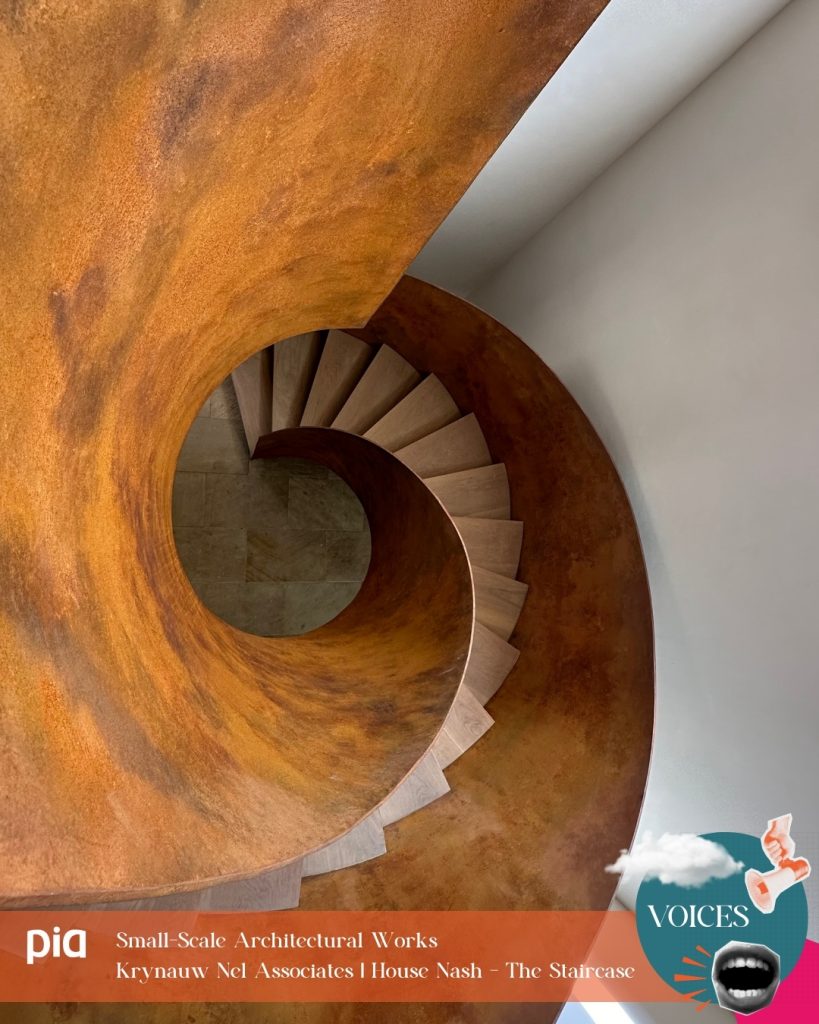
House Nash Staircase
The sculptural spiral staircase is conceived as both a structural innovation and a unifying architectural element. Fabricated entirely from steel, including a 10 mm-thick balustrade, the design draws inspiration from contemporary Italian precedents while reinterpreting them through a more radical structural approach. Rather than relying on conventional support from lower floor levels, the stair appears to float; anchored minimally at the upper level and stabilized through its own continuous geometry.
KNA explored the inherent strength of a single material to create a seamless, monolithic form where structure and finish are indistinguishable. The result is a dynamic, corkscrew-like volume that engages space vertically while maintaining a sense of lightness and precision. As described by Krynauw, the concept can be imagined as “a corkscrew lightly held on only 25% of its edges.” The staircase becomes both circulation and centerpiece—an expressive fusion of engineering and architectural intent.
9. Social Impact Projects
Category Winner
Additions & Alterations to Domus Dei Church
The Domus Dei Church accommodates a wide range of activities, serving various groups for services, concerts, training sessions, examinations, and festivals. Over time, however, the buildings became outdated and could no longer effectively support this growing diversity of uses. Guided by a strong, unified vision from the congregation, a renewal project was initiated.
The main façade was sensitively modernised, with existing stained-glass windows replaced by energy-efficient safety glazing. Along with other carefully considered interventions, this provided a refreshed public presence while respectfully maintaining the building’s overall character.
The low roof over the stoep was replaced with a more generous exposed timber beam structure, enhancing both spatial quality and architectural expression. The kiosk and kitchen were refurbished, and their connection to the stoep improved to encourage interaction, reinvigorating the social life of the congregation.
Toilet facilities were upgraded to accommodate larger groups, and accessibility improved through the introduction of a wheelchair-accessible toilet and ramps. Folding-sliding doors were introduced to the hall alcoves, allowing flexible subdivision for Sunday school and other uses.
The architectural intervention strengthens the church’s role as a vital social anchor within the community, providing a resilient and inspiring framework for future growth.
Livewell – Sub Acute Psychiatric Facility
Most have lived a clinical stay at some time in their life. We get used to a new space, a closed place full of routines where our perception of time changes. The project seeks to qualify all these sensations, building small-scale spaces, comfortable, bright and in contact with nature. Places that the patient can travel and recognize easily, where he feels assisted and at the same time can enjoy freedom and autonomy.
What ultimately tries to build the project is a nearby, diverse and flexible space that is able to accompany the patient throughout his therapeutic development. For this, the project is based on a clear idea: each of the three modules of stay (geriatric, adult and adolescent) in which patients are divided is structured around a courtyard that constitutes the true heart of each community. With this gesture a double objective is achieved, from the external point of view a playful space is created, with benches, porches and vegetation, which is easily controllable by the health personnel. From the inside perspective, the patio constitutes a center around which the corridor revolves, facilitating the orientation of the users in a bright and spacious environment, from which the module can be perceived in its entirety. This structure allows, in fact, that there are crossed views between opposite facades, where the rooms and consultations face the landscape, and the corridor opens to the central courtyard.
The second strategy developed by the project has to do with the readability of the program. The building is divided into four autonomous volumes that are related by a main axis that runs through the building like a backbone. This two and a half meter wide corridors collects the flows of health personnel, visitors, merchandise … communicating the different programs with each other and with the communication centers, which allows the three programs to be reached from the central pavilion in the most direct way possible.
It has been sought to minimize the routes from the access of a patient to his admission, as well as inside each specific unit by means of the system of ring travel around the courtyards. With this strategy, confusion between dark corridors in parallel is avoided, creating a new orientation system around the patio, through the plant elements and lighting that it provides.
On the other hand, a general axis of 3 meters wide connects all the units of the center acting as a backbone to facilitate the different circulations of health personnel, visitors, patients and material to destination.
The exterior of the building is a complementary and fundamental part of understanding the interior of the building. There is a direct relationship between the landscape that surrounds the center with the places of residence of the inhabitants, as this will be a point of reference and observation during their stays. To do this, large openings have been opened on the ground floor coinciding with the most public spaces, such as living rooms, dining rooms … From the rooms a large window to the north and two more contents to the south allow visions and cross ventilation with the central patio. In this way the vegetation, the sun, and the changes in nature participate in the interior rooms mark the time and provide distant looks.
St. Paulus Pool Complex
The St. Paulus Swimming Complex transforms a routine upgrade into a cohesive, regionally grounded facility that supports the full life cycle of swimming development. What began as repairs to the pavilion, pump room, and lookout expanded into a comprehensive enhancement of both the learn-to-swim and main competition pools, completing a vital piece of the school’s sporting and social infrastructure. The design frames swimming as a progression, from tentative first contact with water in a protected learn-to-swim pool to disciplined training and competition in a clear, performance-oriented outdoor pool, creating a spatial narrative of growth, movement, and skill.
Supporting elements reinforce this ecosystem: a central pavilion mediates activity and rest, a lookout provides elevated visibility and communal encouragement, and a clearly resolved pump room integrates technical function with architectural clarity. Material and tectonic decisions root the project in the campus: red brick echoes existing buildings, while a lightweight steel structure with precast concrete slabs enabled efficient off-site fabrication and precise on-site assembly. The result is a legible, purposeful composition that balances performance with place-making. By fostering inclusivity, encouraging progression, and reinforcing community values, the complex strengthens the school’s commitment to holistic education and competitive excellence.
LETHABONG SECONDARY SCHOOL NUTRITION CENTRE
Lethabong Secondary School in Soshanguve forms part of a corporate social responsibility initiative funded by BMW Group South Africa. ARCA was commissioned to design a Nutrition Centre and upgrade existing facilities, with a focus on supporting learner wellbeing within a resource-constrained environment.
The Nutrition Centre is designed as both a functional and social space, contributing to the daily life of the school beyond its primary purpose. Positioned in front of a cluster of established Marula trees, it opens onto a shaded piazza that naturally encourages gathering, connection, and shared experience. This spatial approach draws from an age-old African tradition of meeting beneath trees, reinforcing a strong sense of cultural identity and community.
Through a sensitive integration of architecture and landscape, the project demonstrates how thoughtful design can uplift environments, foster dignity, and create meaningful spaces that support both nourishment and human connection.
Pretoria City Walks
The Pretoria City Walk Tours, led by Adriaan Louw in collaboration with 012 Central, began as an initiative to reconnect people with the city through guided urban exploration. The concept transforms everyday streets into immersive storytelling spaces, revealing the architectural, historical, and cultural layers that shape Pretoria’s identity.
Since its origins in 2014 during Cool Capital, the walks have grown steadily in reach and impact. From four initial walks with approximately 25 participants each, the programme expanded between 2015–2017 into quarterly 012 Central walks averaging 60 participants, with the largest walk hosting 107 people. The initiative has also extended into private and institutional walks, including the German Embassy, Diplomatic Society, and architectural departments from Bloemfontein and Tuks.
Now continued under PIA, the City Walks foster civic awareness, cultural engagement, and architectural appreciation, making them a meaningful platform for public interaction with the built environment.
The Commons
The Commons is not your typical landscape architecture project, although it could and should be. By way of a creative community initiative, a neglected and abandoned piece of land has been turned around completely and changed into a beautiful and functional public space that has become a major asset to the community. The role that landscape architecture played in the initiative was simply to provide a robust and practical design. The result being the creation of a distinct community place that forms the backdrop to daily life allowing residents to go about their routines and also experience special times with their neighbours. The community has bought into the initiative and the number of activities that take place on a regular basis clearly demonstrates the need for similar public spaces in our city. The fact that the park was designed and built by the members of the community with no funding from the Council whatsoever, has resulted in residents taking ownership and looking after the space.
If one assesses The Commons against the definition put forward by the Project for Public Spaces (PPS): “Great public spaces are those places where celebrations are held, social and economic exchanges occur, friends run into each other, and cultures mix. When these spaces work well, they serve as the stage for our public lives.” , then certainly, The Commons, is an exemplary model of this sentiment.

1. Small Scale Architectural Work under R2Mil Budget
Addition Smith – Baumhaus Architects
The original house was designed for the family lifestyle thinking that the patio overlooking the golf course would e a quite space but a few years later the patio was hardly ever used and the need for more guest accommodation arose. My client had a clear vision and wanted the addition to look added on and different from the rest of the house. she wanted a container cantilevering over the existing slab, Unfortunately we could not bring a container over the golf course so we had to re-think. The idea of two boxes placed on the patio was developed resulting in a glass-and-steel box connected to a container-look box. The end result: a playful guest cottage with a beautiful view and a cantilevering box that pops through the existing balustrade. We submit this project to celebrate clients with vision who trust their architects to help materialize their vision.
Office Venter – Earthworld (Pty) Ltd
“A young couple, both immersed in the creative industries—one an artist, the other a media and brand specialist—commissioned two distinct yet harmonious additions to their home: A compact, independent office to support their professional work, and a doll’s house for their daughter, designed as a playful and imaginative space. The brief emphasized minimal disruption to domestic life and seamless integration into the existing home environment.
Design & Manufacturing Process: The project was delivered in collaboration with our sister company, Fourt Revolution, using a rapid and highly digitized workflow: The design was developed in detail and modeled in 3D. The Components were manufactured using CNC (Computer Numerical Control) machines, enabling precision and speed. A complete plywood structural system was used, allowing for efficient prefabrication and clean assembly.
Execution & Timeline: 90% of the building was fabricated off-site in the factory. This allowed for a short on-site construction period, minimizing disruption to the clients’ daily life. The entire project was completed within 8 weeks from the moment we went on site.”
Potgieter Roof – Earthworld (Pty) Ltd
“House Potgieter is located on the rolling hills of the Highveld of Mpumalanga.
Three steriotomic stone walls was used as main axis lines to create order and inform placemaking around the conservatory. Positioning was influenced by predominant August winds and site orientation. Solar heat gain comes from the north, but the view is to the south.
Two mono pitched roofs float on top of the wall plate and are held in place by 20 prominent custom-made plywood rafters supported by steel struts that articulate the southern façade. The modular nature of the roof structure informed the rest of the floor plan layout on a grid of 1.2×2.4m. The floor plan was designed from the bottom down.
Timber shutters were used to create vignettes of the landscape. Once opened one can feel the fresh air of the highveld as well as enjoy the view. On a cold winter day, one can still enjoy the view through the double-glazed windows punched through the stone and masonry walls.
The house is completely of the grid and employs various sustainable strategies to be thermally efficient as well as to minimize the carbon footprint
“
Category Winner
Arangies POD – Earthworld (Pty) Ltd
“Arangies Pod explores whether meaningful, comfortable living can be achieved within just 21 square meters, and whether a fully functional dwelling can be reduced to a 15 square meter footprint. Designed as an independent living space for a university student, the pod demonstrates how compact prefabrication can supply efficient, self contained accommodation with minimal disruption to an existing home. Manufactured off site and assembled rapidly, the lightweight structure attaches cleanly to the main house, showcasing the advantages of precision fabrication and fast installation. Externally, corrugated steel gives the pod a durable, utilitarian presence, while the interior’s exposed plywood provides warmth and intimacy. This contrast between robust steel and refined timber creates an expressive architectural identity that complements the existing building.
Despite its modest size, the pod significantly enhances the property’s functionality by delivering high spatial efficiency and a thoughtful reimagining of the residential addition. Rather than a conventional extension, it becomes an elegant, self-contained architectural object that demonstrates how small-scale interventions can have substantial impact. Its clarity of concept, rapid construction process, and inventive use of materials highlight effective problem solving under tight constraints. Ultimately, the Arangies Pod offers a compelling model for future compact living—efficient, expressive, and proof that small spaces can support rich, comfortable living.”
Solar + Stoep Project – Earthworld
“The design and construction of the solar panel structure was a meticulous process that combined creativity, resourcefulness, and sustainability. To ensure sturdy footings, an innovative approach was employed using 20-liter buckets as formwork with M12 threaded rods submerged into the concrete, providing a strong foundation. Cast concrete fortified shallow footings on sloping terrain, ensuring stability. Precise leveling was achieved by repeatedly testing and adjusting the soilcrete filled holes until perfection.
Aesthetics were thoughtfully considered, drawing inspiration from the colours of South African scaffolding with vibrant yellow paint infusing liveliness into the design. Sustainability was a focal point, with recycled scaffolding materials showcasing Earthworld Architects’ commitment to eco-friendliness and their deep understanding of materials, textures, scale, volume, and detailing ensured that the structure harmonized with its surroundings.
Meticulously fitted baseplates, threaded rods, fine level adjustment nuts and cable bracing enabled seamless solar panel installation. The combination of innovative construction and aesthetics produced a functional and visually striking solar panel structure, demonstrating sustainable design and resourceful construction.
The timber and polycarbonate patio pavilion harmoniously blended sustainability, innovation, and aesthetics. Crafted from recycled tabletops, its main beams and columns showcase a commitment to eco-conscious design, infusing character into the structure. The main beam was seamlessly slotted into place using a pre-installed French cleat. The columns found their footing on casted foundations, grounding the pavilion in stability. Spruce beams, adorned with sprockets and notches, were carefully fitted before being elevated and slid into position. Load-bearing purlins were securely fastened to the rafters.
Honeycomb polycarbonate sheets, attached with tech screws, allow diffused light to grace the patio, creating an inviting ambiance. All the elements interact seamlessly, forming an unintrusive system that celebrates both functionality and aesthetics aluminum flashing neatly finished the edges of the polycarbonate sheets, refining the design. Additionally, four extra solar panels were integrated into the patio roof by utilizing the same purlins as the solar panel structure while preserving the patio roof’s design language.
Rubberized plywood footings accommodated the existing roof’s subpar condition, ensuring a stable foundation for the solar panels. The incorporation of a recycled table, notched into the column added a distinctive touch, reminiscent of its previous purpose. The timber and polycarbonate patio pavilion embodies Earthworld Architects’ distinctive aesthetic and deep understanding of timber design. Its stunning polycarbonate roof bathes the patio in natural light, making it a delightful space.”
CSCC – Earthworld
“Children’s Dream Home is envisioned as a nurturing residence for an orphanage in the east of Pretoria. Commissioned by the CSCC Church, the goal was to create a home that truly embodies the warmth and connection of family living. The design proposal called for a modular structure that could be constructed rapidly—within just eight weeks from start to finish—minimizing disruption and providing immediate benefit to the children.
Children’s Dream Home exemplifies this vision, showcasing both architectural innovation and environmental responsibility. Designed as a low-maintenance, cost-effective three-bedroom home, it features thoughtful spatial planning and the creative use of materials. The exterior is wrapped in corrugated sheeting, lending the house a cohesive, contemporary industrial aesthetic while ensuring durability and ease of upkeep. The use of plywood not only reduces costs but also supports sustainable building practices.
Overall, the design prioritizes sustainability, respect for the natural environment, and a modern industrial aesthetic. By setting a new standard for residential architecture in South Africa, the project demonstrates how thoughtful design can create dignified, inspiring spaces for vulnerable children.”
2. Non-Building Work of Architectural Relevance
Regenarative Design – Earthworld (Pty) Ltd
“Construction methodologies for regenerative development…
mobilising
housing delivery through participatory community engagement
space should embrace TECHNOLOGY, CULTURE, STYLE, NATURE and CONTEXT
space should…
pay homage to the site,
have respect for function,
embrace the natural and man-made order,
be harmonious with nature and climate,
pay service to aesthetic values
The Earthworld mission has matured over the 25-years, by retaining the simple approach to design by incorporating the use of sustainable materials and practices. Furthermore, the idea of considering every project as part of its larger context has been informed by systemic thinking, social regeneration, and the circular economy. Approaching each project with these informants, Earthworld is a leader in the built-environment industry, enabling communities to become self-reliant through democratic industrialisation, vis-à-vis self-assembly projects”
Category Winner
Pretoria City Walks – Louwkul (Pty) Ltd
“The Pretoria City Walk Tours, led by Adriaan Louw in collaboration with 012 Central, began as an initiative to reconnect people with the city through guided urban exploration. The concept transforms everyday streets into immersive storytelling spaces, revealing the architectural, historical, and cultural layers that shape Pretoria’s identity.
Since its origins in 2014 during Cool Capital, the walks have grown steadily in reach and impact. From four initial walks with approximately 25 participants each, the programme expanded between 2015–2017 into quarterly 012 Central walks averaging 60 participants, with the largest walk hosting 107 people. The initiative has also extended into private and institutional walks, including the German Embassy, Diplomatic Society, and architectural departments from Bloemfontein and Tuks.
Now continued under PIA, the City Walks foster civic awareness, cultural engagement, and architectural appreciation, making them a meaningful platform for public interaction with the built environment.”
3. Temporary Instillations & Experimental Work
Category Winner
Block House – Earthworld (Pty) Ltd
“How can development impact communities instead of manipulating them for capital gain? An alternative Economic Model is provided through local material use, skill sharing and development with local trades.
Block Solutions
Plastic waste becomes building blocks which provide a safe interior for inhabitants. Lego-like blocks facilitate the construction process which results in a simple, comprehensible assembly.
Recycling
The blocks’ essential constituent is a sustainable biocomposite mixture of recycled polypropylene and local organic fibers. The carbon footprint is close to zero.
Modular & Cost-Effective
Modularity easers assembly and disassembly without the need for specialists. Construction-ready components and simple building methods enable radical deployment and quick assembly. Little to no construction waste inspirits environmentally responsible design. It generates affordable, durable, lightweight and flexible mass housing solutions. Financial effectiveness is possible due to this innovative product’s material attributes, manufacturing efficiency and construction speed.
Parallel Manufacturing
The architect, as integrator, uses BIM tools as a digital platform to establish SMME’s. Community capital resources or ownership is mobilised when integrating the community with the manufacturing process. A parallel is drawn between the built environment (the architect and BIM systems) and the community – well-schooled in utilising these digital tools and systems. An educated and self-reliant community can assemble the block structure by themselves through local systems thinking.
Alternative Construction Methodologies
Buy, Build, Adapt proposes adaptable infrastructure for schools, housing and shops. Assemble, dismantle and rebuilt! Systemic thinking, sustainability, social regeneration and the circular economy operates hand in hand.
Woman participate in the building process with ease, thanks to a lightweight and highly efficient material. Building is an act of assembling and integrating – a premanufactured puzzle erected within hours”
PLATO Coffee Land Rover – Indigen Architects
Plato Coffee Land Rover translates architectural thinking into a mobile, non-building intervention, transforming a vintage vehicle into a fully off-grid coffee environment. This project explores space-making beyond permanence, using compact design to achieve maximum functionality, efficiency, and experiential richness. It fuses the rugged heritage of Land Rover with the refined identity of Plato Coffee, creating a distinctive, immersive brand architecture. As a roaming micro-venue, it activates diverse contexts, fostering connection and accessibility through design. Its value lies in its ingenuity, adaptability, and narrative power—an unconventional yet compelling expression of architecture as product, place, and experience driven by #Indigenuity.
Ko Spaza – Earthworld
“We set out to develop an alternative approach to constructing buildings, a simpler and more efficient way to build. But more so to build at small scale so that anyone can construct their home, shop or building that they need using only a few basic tools and minimal labour.
A complete plywood structural system – designed in detail and modelled 3-dimensionally in the architect’s office – then sent to CNC (computer numerical control) Machines for cutting and manufacturing of site in components and then rapidly assembled on site.
The construction idea for Ko-Spaza has been in development for more than a year. The idea stemmed from another project in our “R&D department” and when the Ko-Spaza project presented itself we saw the opportunity that this was the project to showcase our design.
From prototyping stage to construction only took a few days. This is a breakdown of how the construction process played out:
A. Design
• Design of building system and components.
• Prototype build of components (as this was a first-time project with this system only a few elements were constructed to see if the system components fit and where improvements can be made).
• Design development from prototype build (revision of components to improve system)
• Detail cutting layouts for components.
B. Factory_Off-site
• Cutting of component elements (2days).
• Assembly of elements to make components (2days).
• Transport to site (the whole spaza shop unit fit on the back of a trailer – “small scale thinking”).
C. Build_On-site
• Unpacking of all elements into component categories.
• Set out of unit on site.
• Build structure with components in sequence (1.5days).
• Flashings and cladding – onsite cutting and fixing (1.5days).
• Services – plumbing and electrical.
The notion of small-scale alternative construction comes from seeing the latent talent that is found in our local communities, where people are pivotal to the success. Using this small-scale concept, we developed a system that could be easily constructed and assembled by locals, using basic tools and labour. In this process of collaboration there is a transfer of knowledge and skill which can be honed to create small businesses within the community, creating a building ecosystem where parts can be manufactured off-site and assembly on-site by different people.”
4. Student-Led or Emerging Architectural Work
Category Winner
From Research-led Design to Co-creation in Melusi informal Settlement
This project presents a co-design approach to micro-scale architectural interventions developed by postgraduate students from the University of Pretoria at two community sites, MYDO 2 (Malusi Youth Development Organisation) and the UP/Rotary COPC Clinic in Melusi informal settlement. Grounded in five years of collaborative engagement and informed by the Co-Creating Wellness Project (2023 to 2025), the work responds to spatial conditions affecting wellbeing, health, and access to community support. Aligned with SANS 10082 for timber frame buildings, the project repositions the architect as facilitator and foregrounds participatory design through design games, analogue and digital tools, and live-build prototyping. Community partners and students worked iteratively to assess mapped conditions, test ideas, and implement contextually responsive interventions. The project is worthy of recognition in this category because it extends architectural practice beyond conventional building production, demonstrating how research-led, socially engaged, and experimentally realised work can support community dignity while advancing creative, participatory approaches to design.
5. Architects as Artists, Makers or Creators
Argitektuur – Abigail Alice le Grange
Argitektuur translates architecture into intimate, hand-crafted artworks that preserve the buildings people love and the heritage that shapes our cities. Each piece begins with research into a building’s history, setting, and defining architectural features, ensuring every illustration is both emotionally resonant and factually grounded. The work reframes architects as storytellers and cultural custodians, using art as a medium to document memory, identity, and place. By transforming significant structures into keepsakes for homes and workplaces, Argitektuur expands architectural influence beyond construction, demonstrating how creative practice can deepen public connection to the built environment while celebrating architectural legacy in an accessible, enduring form.
Casa en el Mediterraneo – Architect Pablo Corroto Pradillo
Casa en el Mediterráneo operates between architecture, research, and experimentation. A monolithic volume is carved into a sequence of voids that construct space through movement, light, and perception rather than form alone. Rooted in Mediterranean tradition yet technologically progressive, the house was remotely constructed through robotic processes while its material envelope was co-developed with Sika. The project questions authorship, presence, and craft in contemporary practice, proposing a new model where architecture is no longer fixed, but continuously negotiated between human intention, machine execution, and environmental context.
Roarstix – Tienie van Rooyen
ROARSTIX reimagines wellness through design. By packaging high-concentration mushroom extracts in single-dose stick sachets, the concept transforms supplementation from a clinical routine into an intuitive daily ritual. Its compact, paper-based format prioritises portability, sustainability, and user interaction—allowing wellness to integrate seamlessly into coffee breaks, travel, and workspaces. In an architectural and design context, ROARSTIX demonstrates how thoughtful product design can influence behavior, encouraging healthier habits through accessibility and form. The system—tube, refill packs, and sachets—creates a circular, minimal & recyclable waste ecosystem. ROARSTIX therefore represents more than a supplement; it is a designed experience that merges functionality, sustainability, and human-centered lifestyle.
Southermost Walk – Paul Boshoff
“Southernmost
People ask me why.
Why do I do this? Why do I walk to the southern tip of Africa every morning and take a photograph?
The answer is difficult, but also very simple.
It’s my anchor.
It’s my hour of power.
It’s the time I meditate. I read. And through my Christian faith, I find grounding. Over the past twelve years, I’ve witnessed miracle upon miracle — simply by walking. Putting one foot in front of the other, no matter the weather.
I look at the conditions and make a deal with myself: take the walk. I think I’ve only turned back once because of bad weather, and even that feels insignificant now.
Through COVID, and even ending up in hospital with seizures, people would ask me, “Are you okay?” And my answer was always simple: if I’ve taken the photograph, it means I’m okay.
This ritual started many years ago, back when I was living in Gauteng, walking my dogs in the mornings. Over time, it changed — from walking physical dogs to walking my mental dogs.
We live in a time where technology moves at the speed of light, yet bureaucracy and people seem to move slower and slower. Our hard drives are overloaded, and time has become our most valuable commodity.
Einstein said, “Life is like riding a bicycle — to keep your balance, you must keep moving.”
So we walk. Every morning.”
Category Winner
Layered Memory Table – Earthworld (Pty) Ltd
“In 2022, the inaugural Future Heirlooms project made a sizeable impact on the local scene when retail brand Always Welcome and the American Hardwood Export Council (AHEC) joined forces to facilitate an art-meets-furniture design collection created by seven South African designers. This time around, AHEC and award-winning furniture manufacturer Houtlander teamed up in the second Future Heirlooms challenge, to explore the future of sustainable collectable design in South Africa.
It kicked off in 2024 when five local cross-disciplinary design studios from our interior design and architecture communities were invited to create collectable furniture pieces that are worth treasuring. Those five were interior architect Juliet Kavishe; costume designer and creative director Bandile Mbuli and architect Ndabo Langa‘s collab Isa-MBU-LA; architect and academic André Eksteen; Cassandra Twala and Johanna von Stein of MOEA Design Studio; and art curator Nkuli Nhleko.
André Eksteen’s – The Layered Memory table – is inspired by geological formations found in the Namibian landscape, and a reverence for material processes, particularly the way geological forces form, shape, settle, intrude on, and then reshape stratified layers. In his design, memory, fable, fact and fiction intertwine to create new truths, and new memories.”